
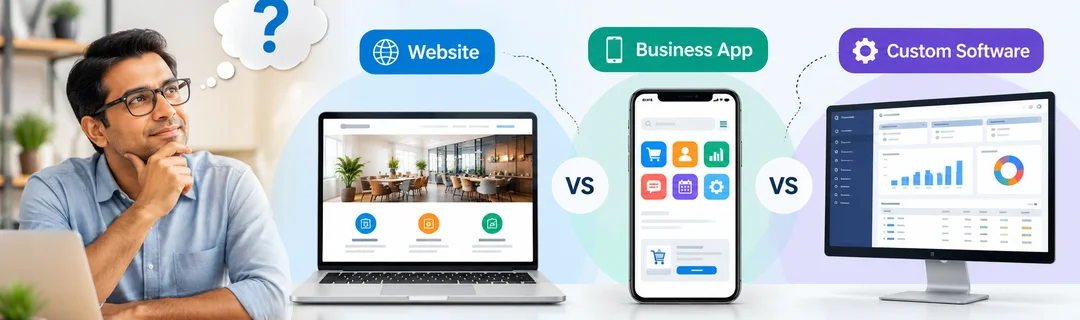
Understanding the Digital Needs of Indian SMEs
Small and medium enterprises in India face unique challenges. From managing inventory in bustling markets of Kanpur to handling online orders from across states, technology choices can make or break growth. Many owners wonder whether a simple website, a custom business app, or dedicated software is the best investment.
The decision often depends on your business goals, budget, customer base, and daily operations. A website might suffice for visibility, while a custom app or software can streamline internal processes. Let's break down each option clearly.
What Is a Website and When Does It Make Sense?
A website serves as your online storefront. It provides information about your products, services, contact details, and can include e-commerce features for direct sales. For Indian SMEs, a well-designed website helps reach customers beyond local areas, especially with rising internet penetration in Tier 2 and Tier 3 cities.
Websites are generally cost-effective to build and maintain. They work across devices without installation. Updates are straightforward, and they integrate easily with digital marketing tools like SEO and social media. If your primary need is brand presence, lead generation, or online selling, a website is often the starting point.
However, websites have limitations for complex internal tasks. They are not ideal for real-time data processing, offline functionality, or handling sensitive business operations like payroll or supply chain management.
PKD Ventures specialises in website development that aligns with local business realities, ensuring mobile-first designs that perform well on affordable smartphones common in India.
The Rise of Custom Business Apps
A custom business app is a tailored mobile or web application built specifically for your company's needs. Unlike off-the-shelf solutions, it matches your exact workflows. For an Indian SME in manufacturing or retail, this could mean an app for field sales teams to update inventory in real time or track deliveries across cities.
Business apps shine in scenarios requiring mobility. Sales representatives can use them on the go, managers can monitor performance dashboards, and teams can collaborate seamlessly. Features like push notifications, offline access, and integration with UPI payments make them highly relevant in the Indian context.
Development costs are higher than basic websites, but the return on investment can be significant through improved efficiency and reduced errors. Many SMEs start with a minimum viable app and scale features over time.
If your business involves frequent customer interactions, logistics, or data collection from multiple locations, a custom business app could transform operations. Explore how business app development can address specific pain points for your team.
Traditional Software Solutions Explained
Software, in this context, usually refers to desktop or cloud-based programs designed for specific functions like accounting, ERP, CRM, or inventory management. These are more comprehensive than apps in some cases and often run on computers or servers.
For Indian businesses, software solutions help with compliance requirements such as GST filing, TDS calculations, and statutory reporting. Custom software development allows these tools to integrate with existing systems, local languages, and regional regulations.
Software tends to be robust for heavy data processing, reporting, and multi-user environments within an office setup. However, it may lack the portability of mobile apps. Cloud-based software is bridging this gap, offering access from anywhere with an internet connection.
Choosing software makes sense when your SME needs deep analytics, secure data storage, or automation of repetitive tasks. It often serves as the backbone for larger operations as the business grows.
Our custom software development services focus on building scalable solutions that grow with Indian SMEs without unnecessary complexity.
Key Differences: A Practical Comparison
Purpose: Websites focus on external communication and sales. Custom business apps emphasise mobility and user engagement. Software targets internal efficiency and data management.
Accessibility: Websites are accessible via browsers. Apps require download but offer better performance. Software can be installed on devices or accessed via cloud.
Cost: Websites usually have the lowest upfront cost. Apps and software require higher investment but deliver long-term savings through automation.
Development Time: A basic website can launch in weeks. Custom apps and software may take months depending on features.
Maintenance: All need updates, but software and apps often involve more ongoing technical support, especially with changing regulations like data privacy laws in India.
Integration: Modern solutions allow integration between websites, apps, and software. For example, a website can feed leads into a CRM software, while an app updates the central database.
Consider your daily operations. A retail SME might need a website for customers, an app for delivery tracking, and software for accounts. Many businesses combine all three rather than choosing one.
Factors to Consider for Your Indian Business
Budget remains a top concern for SMEs. Start with what solves your most pressing problem. If customer acquisition is low, prioritise a website. If operational delays are hurting margins, look at custom software or apps.
Team skills matter too. Solutions that require minimal training work better for smaller teams. Factor in internet reliability – apps with offline modes are valuable in areas with inconsistent connectivity.
Scalability is crucial. Your chosen solution should handle growth, whether expanding to new cities or adding product lines. Security cannot be overlooked, especially with increasing cyber threats targeting Indian businesses.
Localisation features such as support for Hindi, regional languages, and integration with popular Indian payment gateways add significant value.
Before deciding, map your processes. Identify bottlenecks and match them to technology capabilities. Consulting with experts can prevent costly mistakes.
Real-World Scenarios for Indian SMEs
A Kanpur-based apparel manufacturer might use a website to showcase collections and take wholesale orders. A custom app could help sales agents capture orders from shops across Uttar Pradesh. Accounting software would manage compliance and finances.
A food delivery startup could begin with a simple website listing menus but quickly need a business app for order management and driver tracking. Software for inventory and supplier coordination would follow as volumes increase.
Service businesses like consultants or trainers often start with a professional website and later add booking apps or CRM software to manage client relationships efficiently.
The combination approach works best. A website attracts leads, an app nurtures customer relationships, and software handles backend operations.
How AI Is Changing These Choices
Artificial intelligence is influencing all three categories. AI-powered websites can offer personalised recommendations. Business apps use AI for predictive analytics and chatbots. Software increasingly incorporates machine learning for smarter reporting.
For forward-thinking SMEs, considering future AI integration is wise. This might influence whether you choose a flexible custom solution over rigid off-the-shelf products.
We help SMEs incorporate AI thoughtfully, whether through AI video production for marketing websites or AI commercial production to showcase app features effectively.
Making the Right Decision
There is no universal answer. The best choice depends on your specific business stage, industry, and objectives. Many successful Indian SMEs use a combination: a strong website for visibility, custom apps for engagement, and software for operations.
Start small, measure results, and scale. Focus on solutions that solve real problems rather than following trends. Regular evaluation ensures your technology investments continue delivering value.
If you are evaluating options for your business, assessing current processes against potential digital tools is a practical first step. Professional guidance can help align technology with your growth strategy.
Ready to explore the right digital solution for your SME? Connect with experts who understand Indian business contexts.
Tools and Resources for SMEs
Free online tools can help test ideas before full commitment. From website builders to basic app prototypes, experimenting costs little. For more advanced needs, professional development ensures reliability and security.
Staying updated through industry blogs and resources helps SMEs make informed choices as technology evolves rapidly in India.
Visit our blog for more practical technology guides tailored for Indian businesses. For personalised advice on selecting between websites, apps or software, reach out via our contact page.